
Humans didint stop designing, we just upgraded ourselves to the digital sysytem.
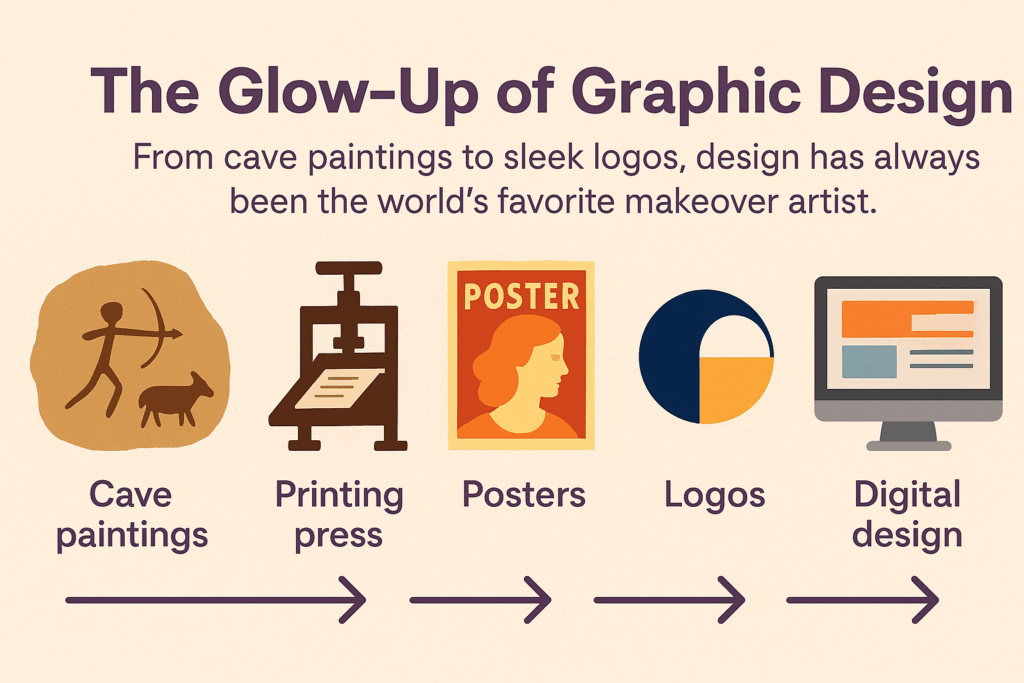
Graphic design has been around far longer than computers or fancy software — humans have always loved turning ideas into visuals. It all started with cave paintings, the world’s first “visual stories,” where people illustrated their daily lives and adventures. In the 1400s, the invention of the printing press changed everything, bringing books, posters, and typefaces to the masses. By the 1800s and early 1900s, movements like Art Nouveau and Bauhaus made design both beautiful and purposeful. Posters became the bold, eye-catching messages of their era — like the social media posts of their time.
In the 1950s–70s, businesses realized the power of visual identity, and iconic logos emerged, shaping how brands communicated with the world. The 1980s and 90s brought the digital revolution, opening up new ways for designers to experiment with visuals, layouts, and creative expression. Then came the internet and social media era, making design a part of everyday life through websites, apps, and online branding.
Today, graphic design continues to evolve with motion graphics, interactive experiences, and new creative tools. But at its heart, it’s still about telling stories, solving problems, and making ideas look amazing — from cave walls to screens, creativity remains timeless.
🎨 A Fun & Quirky History of Graphic Design
🏺 Cavemen: The Original Designers (30,000 BC)
Forget Photoshop brushes — cavemen had sticks, rocks, and cave walls. Their “brand logos” were stick figures and bison drawings. No clients, no deadlines, just pure creativity.
✒️ 1400s: The Printing Press Goes Viral
Gutenberg invents the printing press, and suddenly everyone’s a publisher. Typography became the hottest trend — basically the first font pack drop.
🎭 1800s–1900s: Posters = Instagram Ads of the Past
Art Nouveau, Bauhaus, and Futurism showed the world that design could be both artsy and useful. Posters were everywhere — like the “sponsored ads” of the streets.
📺 1950s–70s: The Logo Boom
Businesses woke up and said, “We need to look cool!” Designers like Paul Rand gave us timeless logos (IBM, UPS, ABC). Logos became the ultimate brand flex.
💻 1980s–90s: The Photoshop Party Era
Computers crashed the party, and suddenly design had layers (literally). Photoshop, Illustrator, and pixel art ruled the scene. Gradients and WordArt? Oh, they had their moment of glory.
🌐 2000s: Design Goes Online
With the internet exploding, everyone needed a website that didn’t look like a mess. Web design, UI/UX, and social media branding took over. Your MySpace page? Yep, that was “graphic design” too.
🤖 2020s & Beyond: AI Joins the Team
Now we have AI tools spitting out logos in seconds, motion graphics everywhere, and design trends changing faster than TikTok dances. But at the core, design is still about one thing: turning ideas into visuals people get.